The Port of Colombo recorded significant growth in container transhipment volumes in April 2026, building upon its record-breaking performance in the previous year.
According to the latest data, transhipment volumes for the month surged by 22.6 percent to 607,240 TEUs compared to 495,456 TEUs handled in April 2025. Cumulatively, transhipment throughput for the first four months of 2026 expanded by 14.2 percent to 2,321,704 TEUs. This ongoing boom follows a historic 2025, during which the port reached an all-time high throughput of 8,291,178 TEUs, cementing its standing as the top transhipment hub in South Asia. Total container throughput at the port climbed 22.0 percent year-on-year to 761,096 TEUs in April 2026.

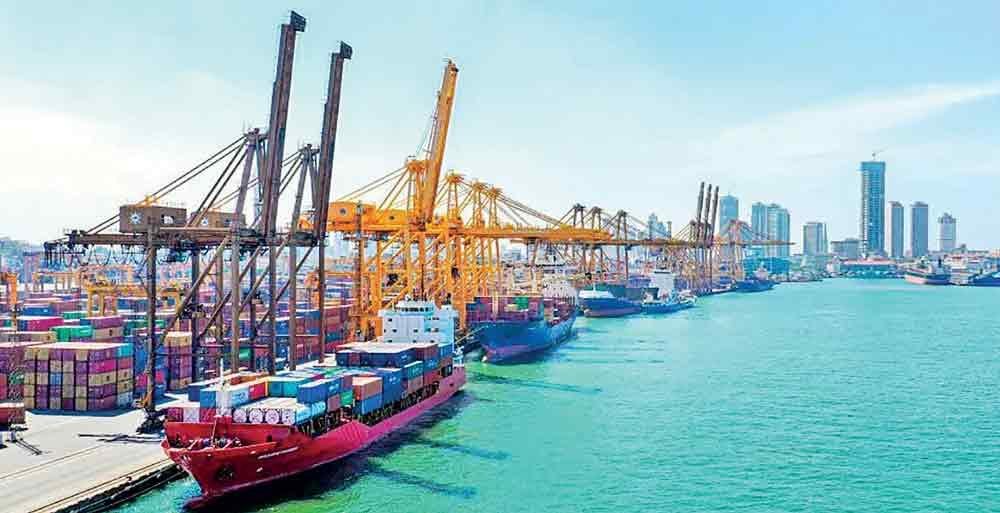
A major catalyst for this momentum has been the rapid scaling of the Colombo West International Terminal (CWIT). Developed under a 35-year Build, Operate, and Transfer agreement by a consortium comprising Adani Ports, John Keells Holdings, and the Sri Lanka Ports Authority, the US$ 800 million facility commenced operations in April 2025. As the first fully automated deep-water terminal in Colombo, CWIT has provided a vital outlet for growth and eased longstanding congestion at existing berths.
The CWIT handled 152,262 TEUs in April 2026, marking a growth of 1124.2 percent compared to the 12,438 TEUs handled during its maiden month of operations last year. For the cumulative four-month period, CWIT’s throughput soared by 3039.9 percent to 502,066 TEUs.
As CWIT absorbs new volume, older facilities are experiencing a shift in traffic distribution. The state-run terminals under the Sri Lanka Ports Authority, comprising the Jaya Container Terminal (JCT), Unity Container Terminal (UCT), and East Container Terminal (ECT), recorded a marginal 0.5 percent decline in April container handling, dropping to 180,952 TEUs from 181,934 TEUs a year earlier.
Colombo International Container Terminals (CICT) maintained its position as the largest single terminal operator by volume, handling 273,417 TEUs in April 2026, representing a 2.6 percent dip from the same month last year.
South Asia Gateway Terminals (SAGT) showed signs of monthly recovery, with its April throughput expanding by 3.8 percent to 154,465 TEUs.
An analysis of the full container throughput reveals a robust performance across domestic cargo segments, with laden container volumes signalling healthy domestic trade activity. Imports jumped 27 percent to 59,287 TEUs compared to 46,677 TEUs in April 2025. On a cumulative basis for the first four months of the year, imports expanded by 9.7 percent to reach 219,227 TEUs.
Meanwhile, the export segment also maintained a positive trajectory where exports recorded a modest increase of 2.6 percent to 23,348 TEUs in April 2026, compared to 22,762 TEUs a year earlier. Cumulatively, exports for the four-month period reached 100,527 TEUs, reflecting a 3.4 percent expansion over the corresponding period in 2025.
To sustain this upward trajectory and navigate a capacity crunch, the Sri Lanka Ports Authority recently unveiled an ambitious investment pipeline reaching up to US$ 2 billion. With the port’s current maximum capacity at 10 million TEUs and demand surging to 9.3 million TEUs, officials have stressed the urgency of expanding infrastructure to mitigate costly vessel wait times. Future phases of CWIT and the upcoming induction of the East Container Terminal are expected to boost overall capacity to 14 million TEUs in the coming years, ensuring Colombo remains an unbeatable logistics center amidst volatile global trade dynamics.
Total cargo handled across the port complex reached 10,498,501 tonnes in April, representing a 9.5 percent increase year-on-year.
By Nishel Fernando (Daily Mirror)